The knowledge that runs your factory is close to retiring. And you still don't have a plan.
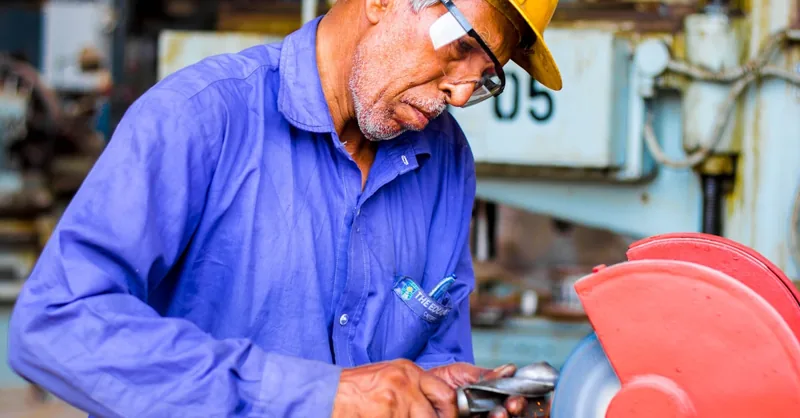
Think about the senior maintenance technician in your operation.
The one who knows exactly what to do when line 3 jams at 2 a.m. on a Saturday. Who knows the failure history of every piece of equipment. Who solves in 20 minutes what would take anyone else on the team 2 hours.
Now think: when they leave, what goes with them?
The answer, in most companies, is: everything. Because it was never documented. Never transferred. And probably never will be, until they announce their retirement and the CEO asks, in a panic: now what?
The risk that doesn't show up on the balance sheet
Every industrial director has at least one person like this. Sometimes two or three.
They're the professionals who carry in their heads decades of operational knowledge that exists in no manual, no ERP and no ISO procedure. They know how the operation actually works, not how the flowchart says it should.
When these people leave, companies lose something that has no line on the balance sheet but a measurable cost. According to Panopto, large companies lose an average of US$47 million a year in productivity as a direct result of inefficient knowledge sharing.
That number isn't abstract. It shows up as:
- Unplanned downtime that takes twice as long to resolve
- Process decisions made on assumption, not on history
- New leaders who repeat mistakes their predecessor had already learned to avoid
- Modernization projects that fail because no one knows how the current operation really works
The risk isn't retirement itself. It's the dependency no one wanted to see before it.
Why companies always find out too late
Synigent Technologies published a study that sums up the problem precisely: the real risk in manufacturing isn't turnover, it's dependency. The problem builds up silently and only reveals itself in a crisis.
The reason companies are late is always the same: succession planning and knowledge transfer get postponed indefinitely to a calmer moment that never comes.
Day to day, the logic seems reasonable:
- The senior technician is here. The operation is running. There's no urgency.
- Documenting takes time. And time is scarce.
- He's still got years ahead of him.
Until he doesn't.
Heidrick & Struggles surveyed 1,921 CEOs and board members worldwide in 2026. The result revealed a significant tension: executives have high confidence in their teams' short-term execution, but that confidence drops sharply when the topic is long-term continuity.
Knowing it's a problem and having a plan for it are two very different things.
The scale of the problem that's coming
The global numbers help size what's happening in industry:
- The Bureau of Labor Statistics projects 963,400 openings a year in production roles between 2024 and 2034, overwhelmingly to replace those who leave, not growth
- 73% of privately held US companies plan a leadership and ownership transition within the next 10 years (Eide Bailly, 2026)
- More than a third of manufacturing executives cite preparing employees to operate in digital environments as their biggest workforce concern (Deloitte)
In Brazil, the problem has an added layer: universities graduate 25,000 engineers a year while industry demands 50,000. That means replacing the senior technician who leaves isn't just hard, in many cases, it's impossible within the timeframe the operation requires.
The window to transfer the knowledge that exists today is closing. And most companies haven't started.
What the companies that protect this knowledge do differently
There's no magic solution to this problem. But there is a method. And the companies that treat intellectual capital as a first-order operational risk share a recognizable pattern:
1. They map dependency before mapping process. The first question isn't how does this process work? It's who knows how this process works? Identifying the key people and the decisions that depend exclusively on them is the starting point, not the org chart, not ISO.
2. They treat documentation as a strategic asset, not bureaucracy. It's not a technical manual. It's the capture of reasoning: why is this decision made this way? What history justifies this procedure? What would the senior technician consider before acting? That content has to be produced while the person is still present.
3. They build overlap before the departure. The transitions that work have a period of parallel operation: the successor works alongside the expert before, not after. That overlap has a cost, but it's a fraction of the cost of the operational crisis that comes when it doesn't happen.
4. They put knowledge risk on the C-suite agenda. This isn't an HR topic. It's a board matter. Which critical process depends on a single person? What's the plan B if they leave tomorrow? Those questions need an answer before they become an emergency.
What Magellan finds in practice
At Magellan Consulting Group, every time we map an industrial operation, one of the first analyses is precisely the knowledge-dependency map: which critical decisions depend on whom, and how deep the bench of trained replacements is.
What we find regularly is unsettling:
- Entire setup, calibration and fault-resolution processes that exist only in the memory of one or two people
- Corrective-maintenance histories that were never recorded, the diagnosis stays with the technician, not the system
- Production-decision rituals that depend on one specific manager's interpretation, with no documented criteria
- New leaders who repeat the same mistakes as their predecessors because no one transferred the learning
We use AI to cross-reference operational data and identify dependency patterns that don't show up in conventional analysis, where the system stops, when it stops, who always gets called. That gives us an objective view of the risk before it surfaces as a crisis.
But technology doesn't solve the problem. It only makes the map clearer. The ones who have to act are the leaders, and they have to act before the retirement, not after.
The uncomfortable point
The technician who knows everything about line 3 probably won't leave tomorrow. But they will leave.
And when they do, the question won't be why didn't we do anything?, because everyone already knows the answer. The question will be how much will this cost?
Because a knowledge crisis has a price. It shows up in line stoppages, in rework, in wrong decisions made by people who lack the context that existed before. That cost rarely reaches the management report under the right name, but it's there.
The difference between the companies that face this problem and the ones destroyed by it isn't size or sector. It's when they decided to confront the risk: before or after the crisis.
Final question: If the most experienced technician in your operation told you today they're retiring in 90 days, what would you discover you don't know?